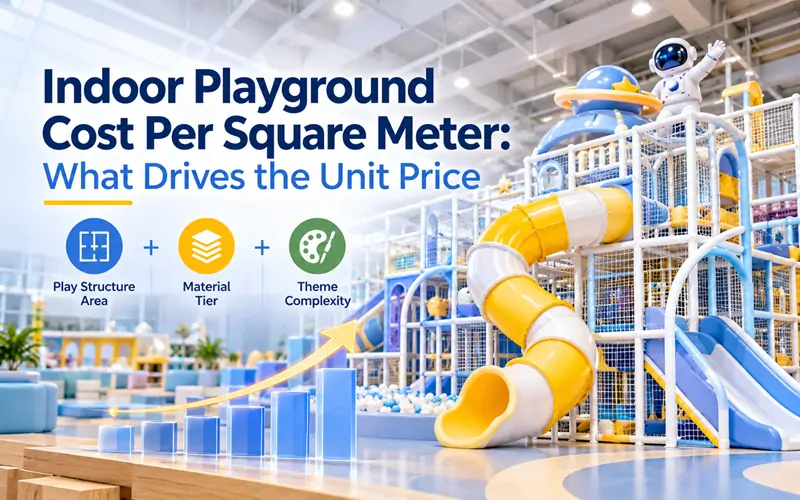
Indoor playground cost per square meter is one of the first figures buyers look for, but it is also one of the most easily misunderstood. The unit price depends on three variables that are often mixed together: the play structure area (not total venue size), the material tier, and the theme complexity. This guide separates those variables, shows how the unit price behaves across different area bands, and explains what to confirm before comparing quotes from different suppliers.
Note: All cost ranges in this article are indicative and based on general market observations. Actual pricing varies by material specification, theme, destination, and supplier terms. Buyers should obtain a formal quotation for their specific project.
What “Per Square Meter” Actually Measures
The first source of confusion is which square meters are being counted. A venue of 500 m² does not mean 500 m² of play equipment. Reception, seating, restrooms, storage, circulation aisles, and party rooms all consume floor area without adding play structure.
When a supplier quotes a per-square-meter price, clarify whether it refers to:
- Total venue footprint — the full leased area.
- Play structure footprint — the actual area occupied by soft play, slides, ball pits, and climbing frames.
- Equipment surface area — the total surface area of platforms, padding, and panels, which can be higher than the floor footprint in multi-level structures.
Most factory-direct quotes for indoor playground equipment are based on play structure footprint, not total venue size. Comparing a per-square-meter price based on venue size against one based on structure area will produce a misleading gap.
The Three Variables That Drive Unit Price
Variable 1: Material Tier
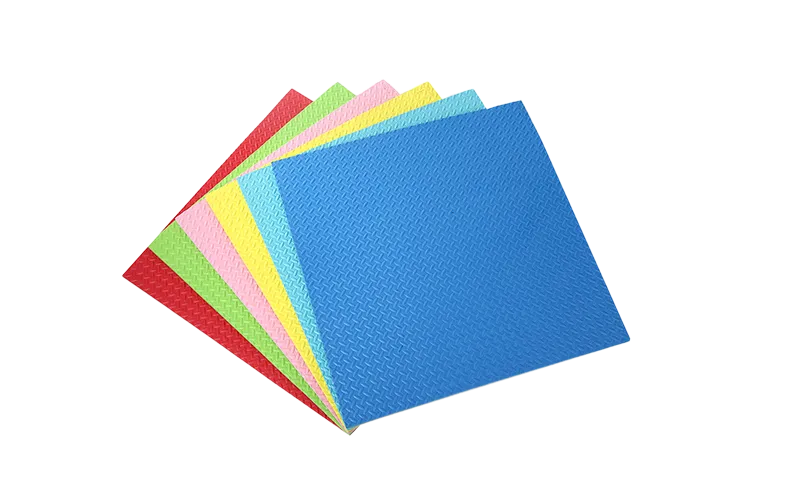
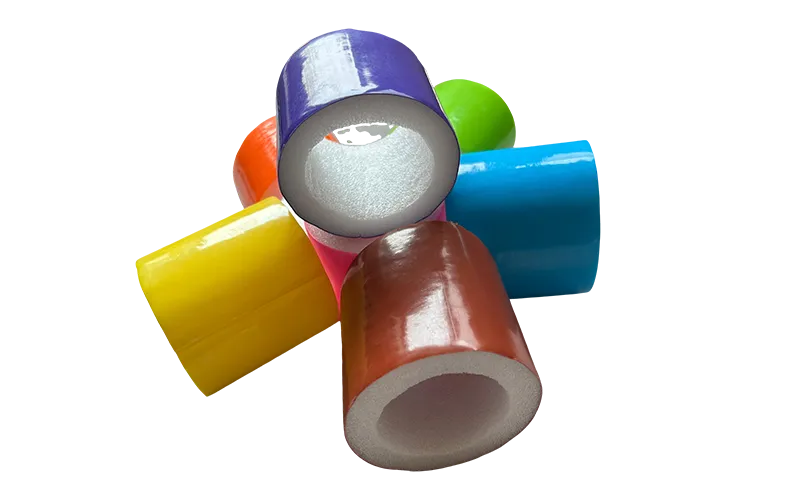
Material tier is the largest controllable driver of cost per square meter. The same design can be produced in economy, standard, or premium specifications, and the unit price gap between tiers can be substantial.
| Material Component | Economy | Standard | Premium |
|---|---|---|---|
| Steel tube thickness | Thinner gauge | Mid-range gauge | Thicker gauge |
| Foam density | Lower density | Mid-range density | Higher density |
| PVC leather | Standard grade | Mid-range grade | Higher-grade, anti-fade |
| Plywood | Standard thickness | Mid-range thickness | Thicker, marine-grade |
| Expected lifespan (high traffic) | Shorter | Standard | Extended |
Specific numerical specifications should be confirmed with the supplier, as they vary by product line and configuration.
A common mistake is to compare per-square-meter quotes from different suppliers without checking which material tier is being quoted. A lower unit price often reflects a lower material tier, not a more efficient production process.
Variable 2: Theme Complexity
Theming adds cost per square meter in proportion to the amount of custom fabrication required. Themes that rely on color and soft sculpting are generally more cost-effective per square meter than themes that require custom fiberglass molds, structural engineering, or integrated electronics.
| Theme Type | Relative Unit Cost Impact | Why |
|---|---|---|
| Pastel / Macaron color scheme | Lower | Color-driven, minimal custom molds |
| Ocean / marine soft play | Moderate | Wave slides, soft sculptures, water-effect lighting |
| Space / LED integration | Moderate to higher | Custom fiberglass forms, lighting systems |
| Jungle / treehouse structures | Higher | Custom structural elements, rope bridges, animal figures |
| Mini city / role-play facades | Higher | Detailed facades, props, lighting, multi-zone planning |
Variable 3: Area Band
Unit price does not scale linearly with area. Smaller structures carry a higher cost per square meter because fixed costs — design, engineering, packaging, and shipping preparation — are spread over fewer square meters. Larger structures can achieve a lower unit price for the same material tier because fixed costs are diluted.
This is why a 100–200 m² project often has a higher cost per square meter than a 500–800 m² project at the same material tier.
How Unit Cost Behaves Across Area Bands
The table below summarizes the general relationship between play structure area and cost per square meter. It is not a price list — it is a framework for understanding how quotes should behave.
| Play Structure Area | Unit Cost Behavior | Typical Project Type |
|---|---|---|
| 100–200 m² | Highest unit cost (fixed costs concentrated) | Cafes, daycares, small retail |
| 200–300 m² | Moderately high unit cost | Community centers, small FECs |
| 300–500 m² | Mid-range unit cost (balanced fixed-cost dilution) | Malls, medium FECs |
| 500–800 m² | Lower unit cost (efficient fixed-cost dilution) | Destination FECs, large malls |
| 800 m²+ | Lowest unit cost potential, but higher total investment | Flagship projects |
If your project falls into the 100–300 m² range, the small indoor playground solutions page explains modular configurations that maximize play value within a compact footprint. For projects in the 300–500 m² range, the medium indoor playground configurations page covers layout options for balanced fixed-cost dilution.
Why Two Quotes for the Same Area Can Differ
Two suppliers can quote the same play structure area and still return very different per-square-meter prices. The gap usually comes from one or more of the following:
- Material tier is different — one quote may be economy, the other standard.
- Play structure area is defined differently — one counts total venue, the other counts structure footprint.
- Inclusions differ — flooring, installation support, pre-assembly testing, or spare parts may be included in one quote and excluded from the other.
- Packaging and container loading differ — inefficient packing increases freight cost, which may be folded into the unit price or quoted separately.
- Warranty and parts archive differ — a longer warranty and permanent parts archive carry a cost that is reflected in the unit price.
Before comparing unit prices, ask each supplier to confirm the material tier, the area basis, and the inclusions. A quote that looks cheaper per square meter may simply exclude items that another quote includes.
What to Confirm Before Using a Per-Square-Meter Quote
Use the following checklist to evaluate whether a per-square-meter quote is comparable:
- Does the quote state the play structure area separately from total venue area?
- Does it specify the material tier (steel gauge, foam density, PVC grade, plywood thickness)?
- Does it state whether flooring, installation support, and pre-assembly testing are included?
- Does it list the warranty period by component?
- Does it confirm the availability of replacement parts after warranty?
- Does it state the packaging method and estimated container count?
If any of these items are missing, the per-square-meter price is not yet a comparable figure.
FAQ
Is indoor playground cost per square meter lower for larger projects?
Generally, yes — fixed costs such as design, engineering, and packaging are spread over more square meters, which can lower the unit price at the same material tier. However, total investment still increases with area, and larger projects may require structural engineering that smaller projects do not.
Does the per-square-meter price include installation?
Most factory-direct quotes are EXW or FOB and do not include installation. Installation is typically quoted separately, either as a factory-guided local crew model or a factory-dispatched supervision model. Confirm the installation model before comparing unit prices.
Why is a 150 m² quote sometimes higher per square meter than a 500 m² quote?
Fixed costs are concentrated in a smaller area for the 150 m² project. Design, engineering, packaging preparation, and minimum production setup costs do not halve when the area halves. This is normal, and it is one reason small projects should focus on modular designs that minimize custom engineering.
Can I get a per-square-meter price without a floor plan?
A rough estimate may be possible, but it will not be accurate. The play structure area, ceiling height, column layout, and exit positions all affect the final design and therefore the unit price. A floor plan is required for a reliable quotation.
What is the most common mistake when comparing per-square-meter prices?
Comparing quotes that use different material tiers or different definitions of “square meter.” Always confirm the material specification and the area basis before comparing the numbers.
Conclusion
Indoor playground cost per square meter is a useful starting point, but it is not a decision-making number on its own. The unit price is shaped by material tier, theme complexity, area band, and what is included in the quote. Buyers who separate these variables can compare quotes fairly and avoid the trap of choosing a lower unit price that reflects a lower specification.
For buyers who want to see how material and area choices play out in real installations, completed playground projects provide reference points across different sizes and markets. And for a project-specific unit price based on your floor plan, contact our design team to request a free 3D layout and a detailed quotation.